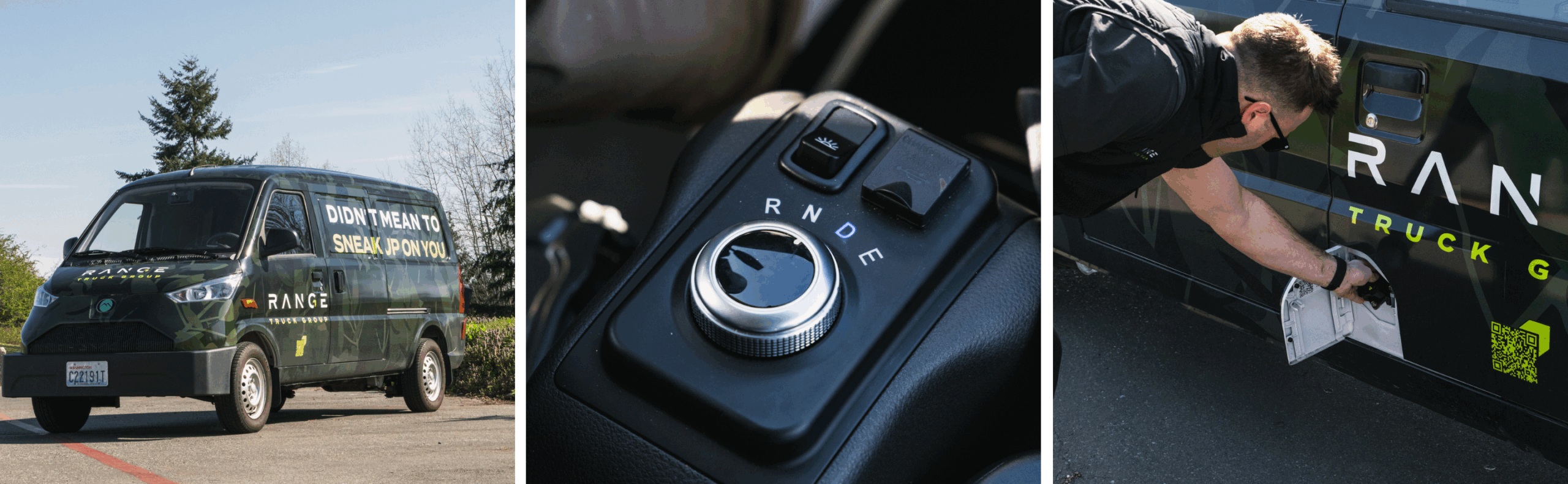

Why Fleet Electrification Started with Vans and Trucks (Not Passenger Cars)
The electric vehicle revolution started in unexpected places: warehouse parking lots, delivery depots, and commercial fleet yards. While headlines often focus on consumer EV adoption, the real transformation is happening where it matters most for the bottom line: in commercial fleets utilizing vans and work trucks driving predictable routes every single day.
This isn’t a coincidence.
Businesses don’t make purchasing decisions based on emotion or environmental messaging, they follow the numbers. And for commercial EV adoption, the numbers have been undeniable for years. Smart fleet managers recognized early that electrifying vans and trucks delivers faster ROI, lower operational complexity, and immediate cost savings compared to waiting for the consumer EV market to mature.
Here’s why commercial fleet electrification started with vans and trucks instead of passenger cars.
The Math Works Better for Commercial Vehicles
The economics of EVs become dramatically more compelling when vehicles drive more miles. According to the U.S. Department of Energy’s Alternative Fuels Data Center, commercial trucks average 45,000 miles annually, more than three times the approximately 13,500 miles that passenger cars drive each year. Some delivery vans and service vehicles exceed 25,000 to 30,000 miles annually on predictable urban routes.
Higher mileage creates a compounding advantage. Every maintenance dollar saved through electrification multiplies across those additional miles. As we explored in our previous analysis of hidden diesel costs, maintenance expenses like oil changes, DEF fluid, filter replacements, and brake work hit diesel commercial vehicles far harder than passenger cars simply because they accumulate miles and maintenance intervals so much faster.
Predictable routes eliminate the range anxiety that plagues consumer adoption. Fleet managers know exactly where their vehicles travel daily. They’re not worrying about spontaneous 400-mile road trips or finding public charging stations. They’re optimizing for known delivery zones, service territories, and return-to-base operations where overnight charging is simple and cost-effective.
Centralized depot charging sidesteps the infrastructure challenge entirely. While consumers debate where to plug in during cross-country trips, commercial fleets install chargers at their facilities and charge vehicles overnight during off-peak electricity hours when rates are lowest. Businesses can also access commercial incentives and utility programs that residential customers can’t, further improving the financial equation.
Predictable Use Cases Make EVs Perfect for Commercial Operations
Commercial fleet operations are tailor-made for electric vehicles in ways that consumer driving simply isn’t. Delivery routes follow established patterns. Service calls happen within defined territories. Vehicles return to central facilities at predictable times.
This operational consistency transforms EVs from a compromise into an optimal solution.
Return-to-base operations mean fleet managers can right-size battery capacity to actual daily needs rather than worst-case scenarios. A delivery van covering 80 miles per day doesn’t need a 300-mile battery pack “just in case.” This practical approach reduces upfront costs while maintaining full operational capability.
Contrast this with consumer psychology: passenger car buyers often demand maximum range for trips they might take once or twice a year, paying premium prices for battery capacity they rarely use. Commercial operators don’t have that need. They calculate exactly what they need and buy accordingly.
Fleet managers can pilot EV programs strategically, testing vehicles on specific routes before scaling adoption across their entire operation. This measured approach minimizes risk while building institutional knowledge about charging patterns, maintenance needs, and driver training requirements. The ability to test and validate in real-world conditions before committing billions makes commercial EV adoption far more pragmatic than consumer adoption, where buyers make individual decisions with less data.
The Maintenance Savings Hit Harder for High-Mileage Fleets
Every day a commercial vehicle sits in the shop represents lost revenue. Missed deliveries. Delayed service calls. Overtime labor costs. Customer dissatisfaction. For businesses, vehicle downtime isn’t just inconvenient—it’s expensive and measurable.
High-mileage commercial vehicles require constant maintenance under diesel powertrains. Oil changes every 10,000-15,000 miles mean multiple service intervals per year for vehicles driving 30,000+ miles annually. Transmission work, exhaust system repairs, and engine maintenance all hit more frequently and more visibly in commercial operations than in passenger vehicles sitting idle 95% of the time.
Commercial operations can quantify downtime costs precisely. A delivery van sitting in the shop costs the business in multiple dimensions: the repair bill, the lost revenue from missed deliveries, the overtime pay for drivers catching up, and potentially damaged customer relationships. EVs drastically reduce unplanned maintenance events, creating predictability that’s worth more than the raw maintenance savings alone.
Businesses Have Always Led Infrastructure Adoption
Commercial fleets have historically been early adopters of transportation technology when the ROI justifies investment. They led the transition to diesel engines, embraced GPS fleet tracking, implemented telematics systems, and optimized routing software, all before these technologies reached mass consumer adoption.
This pattern continues with electrification.
Amazon has committed to deploying 100,000 electric delivery vans from Rivian by 2030, UPS has ordered 10,000 electric delivery vehicles, and FedEx has pledged to electrify its entire parcel pickup and delivery fleet by 2040. These aren’t PR stunts—they’re billion-dollar investments based on rigorous financial analysis. The numbers work, and these companies are acting accordingly.
Governments and utilities recognize this dynamic, offering commercial incentives and programs specifically designed to accelerate fleet electrification. These aren’t feel-good initiatives—they’re strategic investments in infrastructure that will eventually support consumer adoption too.
The Right EV Vehicle for the Right Job
Electric powertrains excel precisely where commercial vehicles operate most frequently. Stop-and-go delivery routes benefit enormously from regenerative braking, which recaptures energy during the constant deceleration that wears down conventional brake systems. Instead of friction and heat, EVs convert that kinetic energy back into battery charge.
Instant torque from electric motors benefits work trucks hauling equipment and cargo. There’s no lag, no transmission shifting, no power curve to manage, just immediate, linear acceleration that makes loaded vehicles feel responsive and capable.
Lower center of gravity from floor-mounted battery packs improves handling and stability when carrying cargo. This is a safety feature that matters when vehicles operate in dense urban environments making tight turns and frequent stops.
Purpose-built commercial EVs are emerging specifically optimized for fleet applications rather than compromised conversions of passenger platforms.
These vehicles prioritize cargo capacity, durability, ease of service, and total cost of ownership over luxury features or aesthetic appeal. They’re tools designed for specific jobs—and that focused engineering makes them better at those jobs than multi-purpose consumer vehicles ever could be.
Businesses can match vehicle specifications to exact operational requirements.
Need 150 miles of range for urban delivery? Don’t pay for 300.
Need specific cargo configurations? Work with manufacturers building commercial-specific platforms.
This customization reduces waste and improves efficiency in ways consumer buyers rarely access.
What This Means for the EV Market
Commercial success is proving EV technology at scale, generating millions of real-world operational miles that validate reliability, durability, and cost-effectiveness. This data informs better vehicle design, reduces manufacturing costs through volume production, and builds supply chains that eventually benefit consumer vehicles too.
The infrastructure commercial fleets are building—charging stations, service networks, parts distribution, technician training—creates the ecosystem that makes consumer EV adoption easier. Public charging networks follow commercial deployment patterns. Service centers gain experience on fleet vehicles before seeing consumer EVs. The path businesses are paving today makes consumer electrification feasible tomorrow.
According to projections from the U.S. Energy Information Administration, electric vehicles are expected to reach 31% of the global light-duty vehicle fleet by 2050. But commercial vehicles will lead that transition, demonstrating the technology works at scale before mass consumer adoption occurs.
Smart Fleet Managers Are Making the EV Switch
The commercial EV revolution is here. Businesses are electrifying their vans and trucks because the ROI is proven, the technology is ready, and staying with diesel means paying more for complexity they don’t need. This isn’t about being “green” for PR purposes. It’s about being competitive and profitable in an industry where every cent per mile matters.
The question for fleet managers isn’t whether to electrify commercial fleets anymore. It’s how quickly they can transition before their competitors gain the operational and cost advantages that electrification delivers. Consumer adoption will follow the path businesses are paving today—but smart fleet managers aren’t waiting for consumers to lead. They’re making the switch because the math works now.
Explore Range’s Commercial EV Solutions
Ready to electrify your fleet? See which electric vehicles might work for your business and browse our lineup. You can connect with our team to discuss your specific needs:
- Range’s Electric Semi Trucks Long-haul and regional solutions
- Range’s Last-Mile & Delivery Vehicles Perfect for solopreneurs and delivery fleets
- Range’s Work & Utility Trucks Service trucks for contractors and tradespeople
- Range’s Two Wheel EVs Two-wheel EVs built for work, patrol, delivery
Unsure where to start? No fleet is too small to make the switch. Let’s find the right starting point for yours.:
- Contact Our Team Get personalized guidance for your fleet
- Subscribe for Updates EV news, industry analysis, and product updates